
Shale Markets Briefing — October 16, 2026
Friday, October 16, 2026
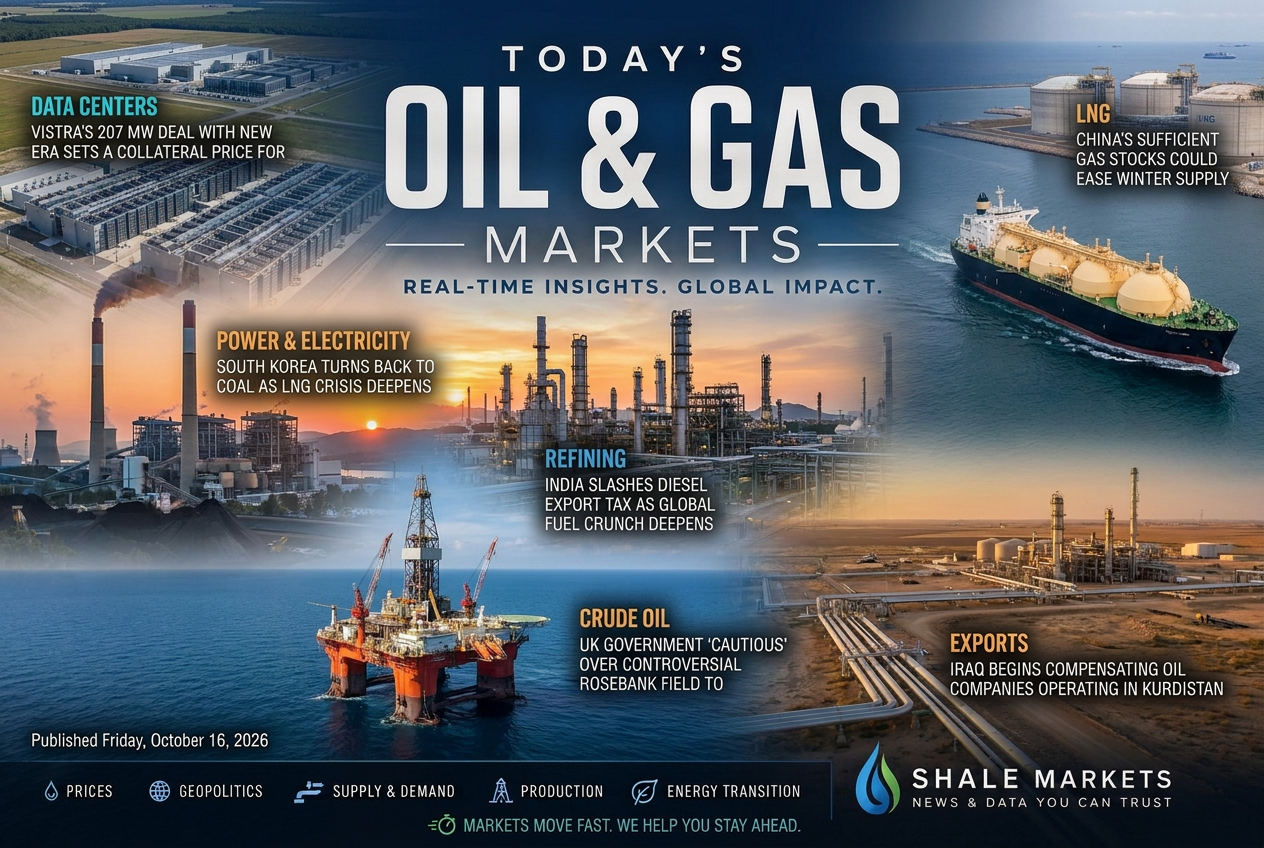
Today's briefing brings you 20 stories across data centers, lng, refining and crude oil from across the global oil and gas market. Leading today: Vistra's 207 MW Deal With New Era Sets a Collateral Price for Permian Data Center Power.
data-centers
Vistra's 207 MW PPA with New Era comes with a $198.8 million collateral package and a 5% equity stake, setting a price template for Permian data center power deals.
From Our Desk
lng
China’s early stockbuilding reduces the risk of a winter scramble for LNG and suggests softer spot demand from the world’s biggest importer. For producers and traders, that can ease competition for cargoes into Asia and Europe and improve near-term supply balance.
OilPrice.com
South Korea’s shift back toward coal shows how LNG shortages and disrupted Middle East supply can quickly change power-fuel economics in Asia. For gas producers and LNG exporters, it signals weaker near-term demand flexibility and a harder winter market for spot cargoes.
OilPrice.com
ExxonMobil taking a larger operating role at Papua LNG signals that the project is moving from planning toward execution, which matters for capital allocation in Asia-Pacific LNG. For executives, it suggests progress on a large gas supply source that could tighten competition for LNG feedstock and reshape development priorities in the region.
Upstream Online
refining
India’s export duty changes can shift diesel barrels back into the global market while tightening gasoline outflows, which matters for refiners and traders watching near-term product balances. For executives, it is a signal that policy in a major refining hub can quickly redirect export flows and affect margins across Asian and Atlantic Basin fuel markets.
OilPrice.com
Honeywell’s role in this expansion shows Hengyi is still committing capital to long-lived refining capacity in Brunei, which can tighten the company’s position in Asian fuels and petrochemical supply. For executives, it signals continued investment in downstream assets rather than a pullback to maintenance-only spending.
OGJ - Refining & Processing
crude-oil
The UK government’s caution around Rosebank signals that even large North Sea developments still face political and regulatory friction before capital is committed. For operators and investors, that keeps sanction timing and final project economics tied to permitting risk rather than reservoir size alone.
The Herald
Iraq’s move to make up export payment shortfalls in Kurdistan signals progress on a long-running commercial dispute that has constrained crude flows and delayed cash recovery for operators. For executives, it points to a potential easing of payment risk in a region where fiscal terms and export reliability directly affect capital allocation and development plans.
Rudaw
The headline signals that diesel, not crude, is the tighter part of the barrel and that refinery bottlenecks in key exporting regions can keep distillate margins elevated even if crude supply improves. For executives, that points to sustained upside for refining capacity, product trading, and logistics assets that can move or make diesel.
OilPrice.com
Exxon’s Guyana oil ramp is reshaping the country’s gas strategy, because associated gas that might have supported LNG exports could instead be reserved for domestic power and industry. For executives, this signals that upstream growth can tighten control over gas molecules and shift capital toward local infrastructure rather than export optionality.
OilPrice.com
OPEC+ using the Saudi conference as a venue for talks signals that producers are still actively managing supply policy and market discipline. For upstream and LNG executives, even a short meeting like this can hint at whether the group is leaning toward tighter or looser output, which affects basin economics and capital allocation.
RigZone
This signals that easing restrictions on Russian diesel may not materially increase available supply, so traders and refiners should not assume a quick bearish impact on middle-distillate balances. For executives, the bigger takeaway is that geopolitical policy changes can shift price expectations without immediately changing physical barrels, keeping export and refining margins volatile.
OilPrice.com
A tighter rig count with steady or higher output signals improving drilling efficiency in the Bakken, which supports basin productivity even as activity levels soften. For executives, that points to continued capital discipline and a reminder that service demand and takeaway needs may not fall as fast as rig counts suggest.
KFYR-TV
U.S. crude inventories fell sharply, which points to a tighter near-term supply balance and can support prompt crude pricing and refinery feedstock planning. For producers and refiners, the read-through is whether draws are being driven by stronger runs, exports, or lower upstream supply.
OGJ - General Interest
This signals how concentrated India’s crude sourcing remains, which matters for refiners and traders watching supply security and bargaining leverage. A narrow supplier mix can leave import costs and run rates more exposed if one of those flows is disrupted or rerouted.
The Hindu
Keeping Angola above the 1 million barrel-a-day mark signals an effort to defend national cash flow and preserve its role as a meaningful OPEC producer. For oil executives, it points to a market where maintaining mature output still matters more than growth, which can influence contract timing, service demand, and competition for upstream capital in Africa.
RigZone
Midstream
This signals another upstream and gathering separation, which can sharpen National Fuel’s capital allocation by letting the market value the production and midstream pieces separately. For Appalachian peers, it is a reminder that scale in gas-weighted assets and gathering systems can still be monetized through portfolio simplification rather than new drilling alone.
World Oil - Latest News
Drilling
Senegal’s move to open a large block offer signals a fresh bid to attract upstream capital and re-rank the country in West Africa’s exploration pipeline. For operators, it points to new acreage competition and a potential path to rebuild drilling optionality if fiscal terms and geological prospectivity are attractive.
Oil Review Africa
Khalda’s cost reduction signals that operators are pushing for more wells from fewer rigs, which matters for capital discipline and drilling efficiency in a cost-sensitive upstream market. If those savings are repeatable, it can support continued activity while lowering breakeven costs and improving competitiveness in the basin.
Oil & Gas Middle East
BW Energy’s appraisal success in Dussafu supports adding more production wells, which signals that the area can still attract development capital rather than just maintenance spending. For executives, the key takeaway is that offshore African oil projects with proven reservoirs can continue to progress into incremental growth phases even in a tighter capital environment.
OGJ - Exploration and Development