
Today’s Briefing

The latest drilling, deal-flow, and regulatory news across the globe

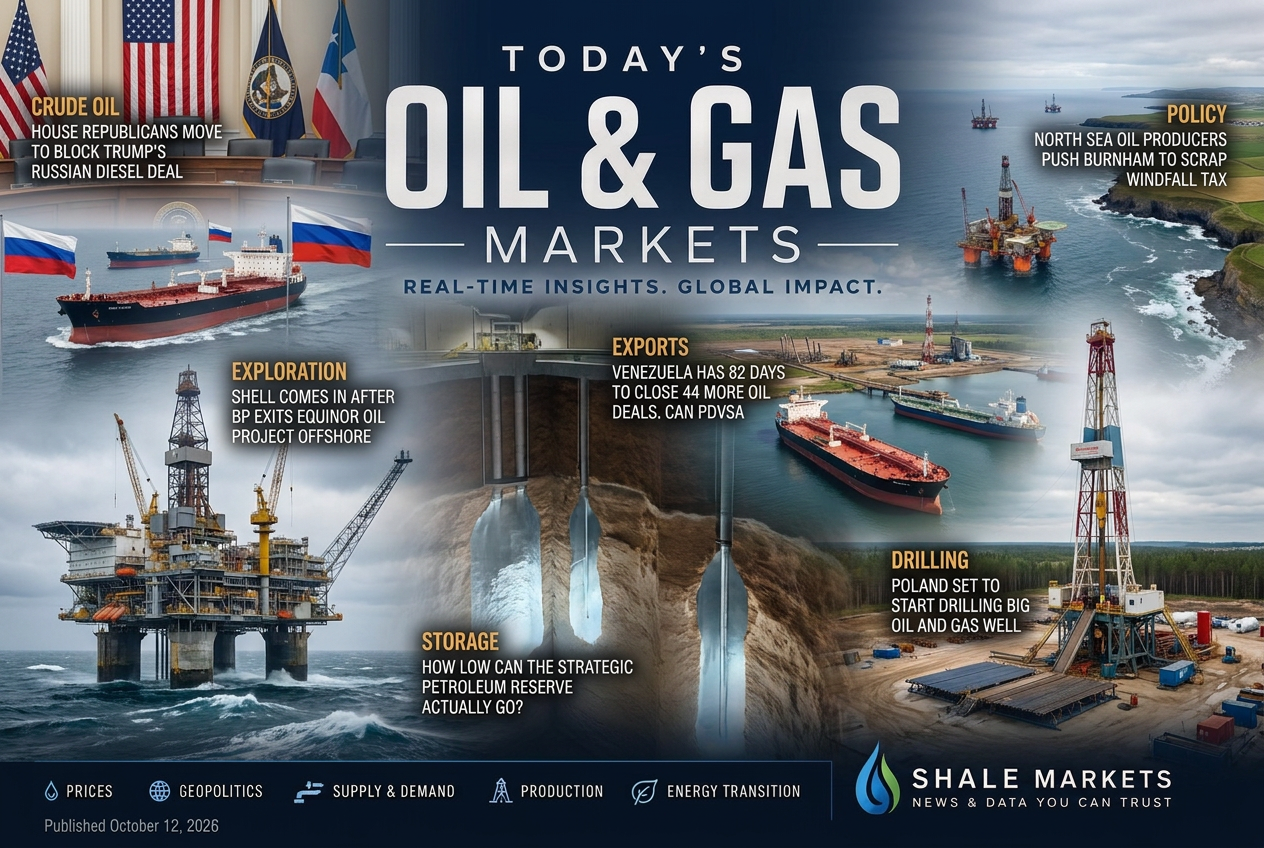
Illustrated summary of the top stories in the Shale Markets Briefing — October 12, 2026 briefing

Thursday, September 17, 2026

SOCAR Enters Africa

SOCAR’s move into Africa signals that national oil companies are still reallocating capital toward new upstream growth areas outside their home regions. For competitors, it is a reminder that African acreage remains attractive for long-cycle reserve replacement and international portfolio diversification.

OMV Confirms Viability of Libyan Oil Discovery

The commerciality call on OMV’s Libyan discovery signals that new barrels in the Sirte Basin can still be converted into development opportunities, which matters for future capital allocation in a country where investment decisions are closely tied to reserve quality and operating risk. For executives, it is a reminder that North African exploration still offers meaningful upside if projects can clear viability hurdles.

Alberta Plans New Royalty Incentives to Spur Oil Production

Alberta is signaling it will use fiscal incentives to pull more capital into new upstream projects, which matters for producers weighing where to deploy drilling dollars in a higher-cost environment. If the framework is attractive, it could lift Canadian crude growth and support more export volumes to Asia, improving the province’s competitive position against other supply basins.

Why Bill allowing Trump to impose 100% tariff on Russian oil buyers is a double-edged sword

This signals a new sanctions risk for Russian crude flows and for buyers that could be forced to choose between access to discounted barrels and exposure to punitive tariffs. For oil executives, the bigger issue is how such a measure could reroute trade, tighten some supply lanes, and create fresh compliance and pricing uncertainty in Asian and global markets.

Yoon pushed East Sea oil, gas drilling despite uncertainties, audit finds

The audit suggests the East Sea drilling push may have advanced ahead of clear subsurface and commercial certainty, which matters for how much capital Korea will commit to frontier exploration. For executives, it signals that policy support can drive basin activity even when project risk remains unresolved, affecting partner interest and timing of investment decisions.

BKV Completes Acquisition of Barnett Shale Upstream, Midstream and CCS Assets

BKV has consolidated Barnett assets that combine production, gathering and carbon capture, which points to a strategy of controlling more of the value chain rather than just adding wells. For executives, it signals continued capital interest in mature gas basins where midstream and CCS optionality can improve economics and future positioning.
Sponsored
Ray's Gym Tracker

Wednesday, September 16, 2026

Shale Markets Original

Get the daily briefing

Join oil & gas executives who start their day with Shale Markets.

New gas suppliers sought as prices spike

Thailand’s effort to line up new gas suppliers suggests buyers are trying to lock in alternative supply before higher prices tighten margins or expose them to spot-market volatility. For producers, LNG traders, and midstream counterparties, it signals a chance to win market share if they can offer reliable volumes and competitive terms.

Shale Oil Now Makes Up 72% of Argentina's Crude Output, Data Shows

Vaca Muerta’s rising share of Argentina’s crude output signals that capital and drilling are concentrating in the shale play even as the broader economy weakens. For operators and investors, it underscores that Argentina’s upstream growth is increasingly tied to one basin, which can reshape export volumes and competition for rigs, services, and midstream capacity.

Saudi Oil Crisis Is About to Hit Europe

The attacks on Saudi Arabia’s east-west export line highlight how quickly a production disruption in the Gulf can ripple into Europe’s crude supply chain. For operators and traders, the key issue is not just lost barrels but the increased premium on alternate routes, storage, and cargo sourcing when Hormuz-linked flows are constrained.
Sponsored
Newsletters Automation & Hosting Platform

Continental Resources, PDVSA sign MoU for potential Venezuela oil development

The agreement signals another push by an upstream company to secure a foothold in Venezuela’s Orinoco Belt, where scale matters but so do political and operating risks. For executives, the key issue is whether this opens a path for capital to chase large resource upside in a sanctioned, high-friction basin if terms and control can be made workable.

Get the daily briefing

Join oil & gas executives who start their day with Shale Markets.

OGJ - Refining & Processing · 12:20 PM

Muse, Stancil and Co Refining Margins

Refining margins are a direct read on downstream profitability and can shift how much capital refiners are willing to allocate to runs, turnarounds, and incremental capacity. For executives, the signal is whether product spreads are strong enough to support operating rates and protect earnings in the refining chain.

Hormuz Risk Opens $40-Plus Price Gap Between Crude Grades

The widening spread between Gulf-linked crude and more secure barrels signals that shipping risk is now a direct pricing variable, which can reshape crude sourcing and contracting decisions. For executives, it points to potential supply disruption around the Strait of Hormuz and a stronger advantage for grades that can reach market without that exposure.
Sponsored
AI-Driven Interactive Websites

Showing 426–450 of 1293
