
Today’s Briefing

The latest drilling, deal-flow, and regulatory news across the globe

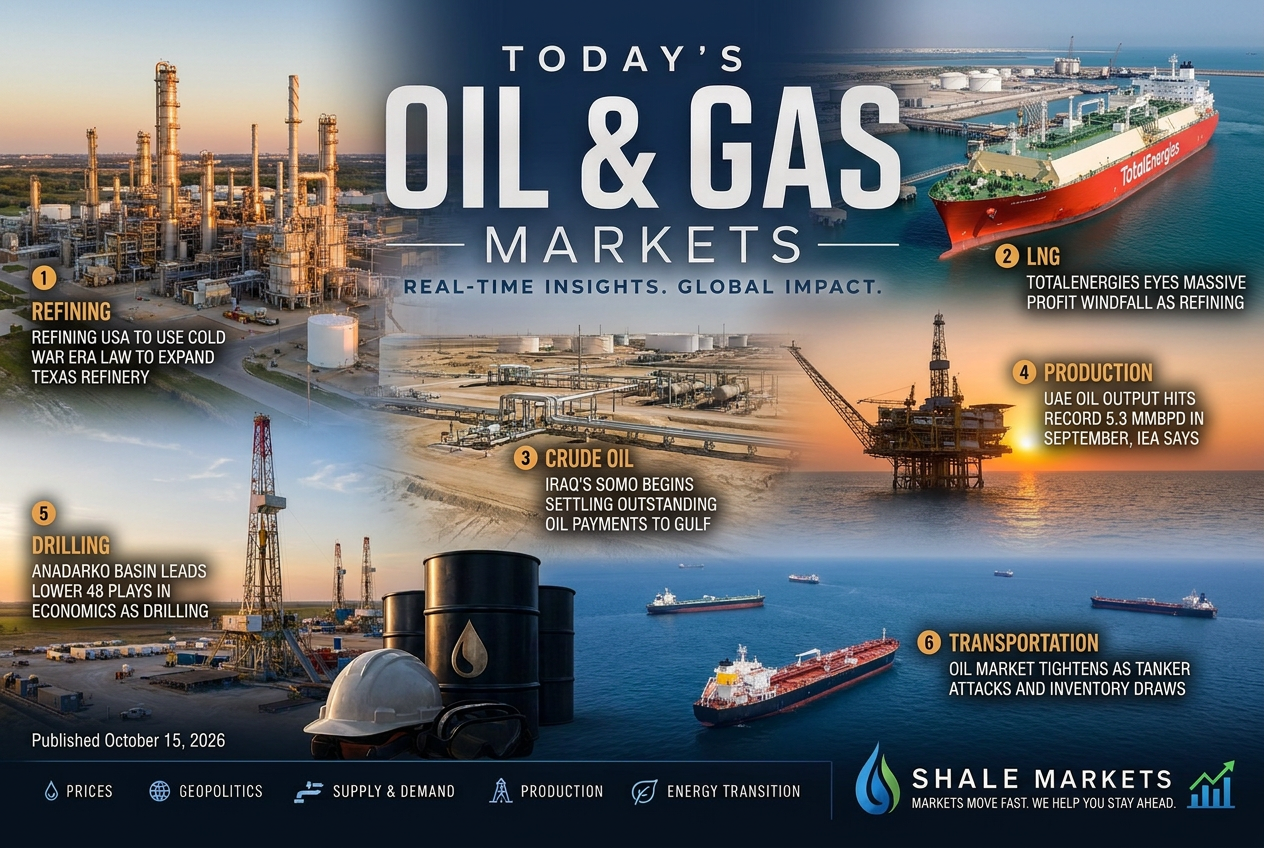
Illustrated summary of the top stories in the Shale Markets Briefing — October 15, 2026 briefing

Tuesday, August 11, 2026

Brent Could Hit $100 as Hormuz Crisis Flares Again

A renewed Hormuz risk adds a geopolitical premium to crude and can quickly tighten global supply expectations, which matters for hedging, feedstock costs, and upstream capital timing. If Chinese buyers lean harder into Iranian barrels, it also signals shifting trade flows that could alter sanctions exposure and competitive positioning for sellers with access to discounted crude.

Congress Targets Putin's Oil Lifeline With Tough New Sanctions

Tighter U.S. sanctions on Russian oil would raise the risk premium around seaborne crude and force traders, refiners, and shipping firms to reassess exposure to barrels linked to Russia. For executives, the main signal is potential disruption to global supply flows and a possible shift in sourcing and freight economics rather than a direct change in U.S. upstream activity.

African Energy Chamber Backs Venezuela’s Efforts To Attract Upstream Oil And Gas Investment

Venezuela attracting upstream capital matters because any improvement in investor access could slow the country’s production decline and alter crude supply expectations for heavier grades. For operators and financiers, it signals whether sanctions, contract terms, and political risk are becoming manageable enough to justify renewed basin-level spending.
Sponsored
AI-Driven Interactive Websites

Is Spartan Delta (TSX:SDE) Fully Valued On Higher Earnings And Raised Guidance?

Higher earnings and raised guidance usually signal improving well productivity or tighter capital discipline, which can support equity rerating if investors see the growth as durable rather than driven by short-term pricing. For competitors, it can indicate that Spartan Delta has more room to allocate capital toward drilling and production without stressing the balance sheet.

Natural Gas Services Group lifts 2026 EBITDA outlook

Higher EBITDA guidance from a gas-focused service provider suggests better utilization and pricing for compression and related equipment, which can point to steadier upstream activity in gas-weighted basins. For executives, that is a signal to watch whether service costs are firming and whether capital is still flowing toward natural-gas development rather than oil-led programs.

Get the daily briefing

Join oil & gas executives who start their day with Shale Markets.

Sonangol’s Sebastião Gaspar Martins Joins Angola Oil & Gas (AOG) 2026 as Angola’s Hydrocarbon Strategy Takes Shape

Sonangol’s visible role in this forum signals that Angola is still shaping its upstream agenda around national oil company leadership and outside capital engagement. For operators and investors, that points to a market where access, policy direction, and future acreage or project terms may be influenced by how the government balances production growth with partnership appeal.

Colombia Revives Oil And Gas After Four-Year Renewable Energy Push

A policy reversal in Colombia matters because it can reopen acreage and long-cycle investment opportunities in a major Latin American producer, which affects regional supply growth and the competitive position of firms seeking reserve replacement. It also signals that capital may start shifting back from renewables-only priorities toward upstream oil and gas projects if the government becomes more receptive to exploration.
Sponsored
Newsletters Automation & Hosting Platform

Ukraine Hits Major Taneco Oil Refinery

Attacks on Russian refining and petrochemical assets raise the risk of product supply disruptions and wider volatility in regional fuel balances. For executives, it underscores growing geopolitical exposure for downstream operations and the potential for tighter near-term margins in affected markets.

Get the daily briefing

Join oil & gas executives who start their day with Shale Markets.

America's $4 Billion Wind Retreat Is a Bet on Permanently Cheap Gas

The retreat from offshore wind signals that capital is being redirected toward lower-cost, quicker-payback supply, which strengthens gas's position in the U.S. power stack. For executives, it suggests less competition from renewables in balancing electricity demand and a policy environment that may favor gas-linked infrastructure and generation over higher-risk clean power projects.

Iraq’s Oil Lifeline Reopens — But Can Baghdad Trust Turkey for Even One Year?

The reopening of Iraq’s export route signals how dependent Baghdad remains on uninterrupted crude flows to fund the state, so any route disruption can quickly turn into production curtailments and fiscal stress. For exporters and traders, the issue is less about a single shipment than about whether Iraq can sustain volume and reliability in a constrained regional logistics environment.
Sponsored
Newsletters Automation & Hosting Platform

Showing 1276–1300 of 1375