Dallas Fed Survey Shows E&P Firms Favoring Buybacks Over Barrels as Uncertainty Index Hits 40.2
Original illustration created for Shale Markets.

Dallas Fed Survey Shows E&P Firms Favoring Buybacks Over Barrels as Uncertainty Index Hits 40.2
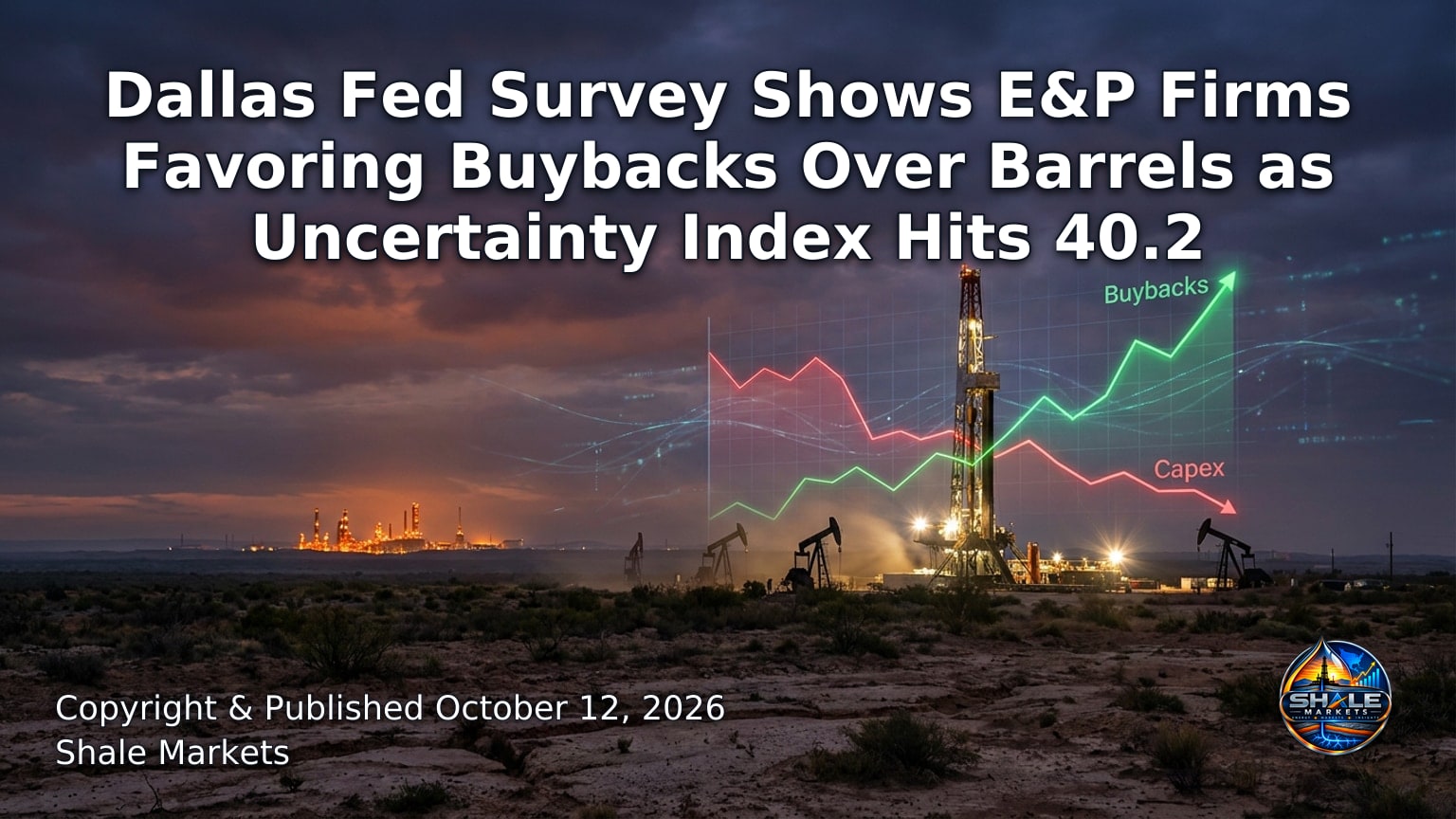
Large exploration and production firms told the Federal Reserve Bank of Dallas in September that they would rather pay shareholders than drill. Fifty percent of large E&P respondents in the bank's Q3 2026 Energy Survey, published September 30, said they plan to direct additional cash flow toward capital returns; only 21% picked capital expenditures as their top priority. American Oil & Gas Reporter, in an October 11 writeup of the same survey, put the production footprint of that cohort at more than 80% of domestic output. That figure is AOGR's own characterization of the large-E&P segment; the Dallas Fed's release does not itself report a production-share breakdown for its respondent pool.
The business activity index that anchors the quarterly survey slipped to 38.8 from 46.1 in the prior quarter, the Dallas Fed reported. It stayed positive, meaning respondents still described conditions as expansionary. But the uncertainty gap between segments widened sharply: E&P firms logged an uncertainty reading of 40.2 against 9.5 for oilfield services firms, a split the bank's own release flagged as significant.
Spot Traded Near $99 While Respondents Penciled In $88
Oil was trading at $98.70 a barrel, according to Energy In Depth's October 8 account of respondent comments. The outlet does not specify what date within the survey window that print reflects, and no second source in the available record confirms it; it should be read as Energy In Depth's figure alone. Despite that spot level, survey respondents told the Dallas Fed they expect WTI to average $88 a barrel by year-end 2026, falling to $79 two years out — figures World Oil confirmed in its own September 30 writeup of the same release.
That gap between spot and forward expectations is the planning problem. An E&P executive wrote in response to the survey that "pricing volatility is near an all-time high," according to Energy In Depth, with swings of $10 to $20 a barrel becoming routine. Multimillion-dollar drilling programs have to pencil out against the price operators expect in 2028, not the number on the screen today, which is why a $99 tape has not translated into new rigs.
Capex Indexes Moved in Opposite Directions
Novi Labs' October 5 analysis of the survey data found the current capex index moderating to 32.8 from 40.9 in the prior quarter — a retreat consistent with the shareholder-returns preference large firms reported directly to the Dallas Fed. The expected capex index for 2027, however, climbed to 17.1, which Novi Labs read as early evidence that firms are starting to commit to next year's budgets even as this year's spending cools. A separate, frequently repeated figure — that nearly 80% of executives delayed investment decisions on price uncertainty — comes from a Domestic Drilling and Operating report dated September 2025 describing an earlier survey, not this one, and does not belong in this quarter's count.
Costs are part of why. The finding and development costs index stood at 41.5 in the Q3 survey, World Oil reported. As a diffusion index, that reading means a net 41.5% of respondents reported rising F&D costs more than those reporting declines — a clear net-rising signal, not a comparison against a historical growth rate. Novi Labs separately found that roughly 97% of Permian base-case inventory breaks even at or below $65 a barrel on an NPV10 basis, a threshold that still clears the forward curve the survey implies, with less room than operators had when spot traded above $90.
Breakevens Are Rising Even as the Rock Gets Harder
The Journal of Petroleum Technology, citing the same Dallas Fed survey in an October 9 piece on deepwater economics, put new-well breakevens across core US shale plays in the $61 to $70 range, driven by service-cost inflation and longer laterals chasing thinner rock. JPT's broader argument — that deepwater project costs are compressing while shale's are not, potentially undercutting shale on marginal cost by late 2026 — is one outlet's framing built on the same survey data, worth treating as a thesis rather than a settled number.
Production Still Rose in October's EIA Numbers
None of this has shown up in near-term output yet.
EIA's Annual Energy Outlook 2026, published in April, projects US crude production fluctuating in a narrow 12.4 to 12.7 million barrel-per-day band through 2050 in most cases, with Brent staying below $70 a barrel in real terms through 2030. That long-run projection runs on a different modeling horizon and price case than the October STEO's near-term forecast, which is why a 2050 scenario and a 2026-27 update don't read as the same story. Current wells are producing more than forecast while the capital that would sustain growth past 2027 shifts toward buybacks and dividends.
Sources
This article was reported from the following sources.
- Oil and gas activity increases despite cost pressures, longer supplier delivery times — Federal Reserve Bank of Dallas, 2026-09-30
- Dallas Fed Survey Logs Q3 2026 US Output Gain, Flags Price Uncertainty — EnergyNow, 2026-10-10
- Dallas Fed: U.S. oil and gas activity expands despite rising costs — World Oil, 2026-09-30
- Dallas Fed Energy Survey Q3 2026: Key Takeaways and Analysis — Novi Labs, 2026-10-05
- Short-Term Energy Outlook: October 2026 — U.S. Energy Information Administration (EIA), 2026-10-08
- Dallas Fed's Third Quarter Survey Highlights Continued Growth — American Oil & Gas Reporter, 2026-10-11
- Dallas Fed: The Oil Patch Is Growing, and Permitting Reform Decides How Fast Relief Arrives — Energy In Depth, 2026-10-08
- Annual Energy Outlook 2026 — U.S. Energy Information Administration (EIA), 2026-04-08
- US Shale Oil Breakeven Price Set to Hit $95 — Domestic Drilling and Operating, 2025-09-28
Links Verified at Time of Publish.