
Shale Markets Briefing — October 13, 2026
Tuesday, October 13, 2026
Today's briefing brings you 33 stories across production, natural gas, crude oil and lng from across the global oil and gas market. Leading today: How Do Appalachian Energy Contractors Actually Manage Prequalification?.
Markets
Safety and compliance staff at oil, gas and energy contractors are invited to share how they handle ISNetworld, Avetta and Veriforce. It’s an anonymous email questionnaire of eight short questions.
From Our Desk
production
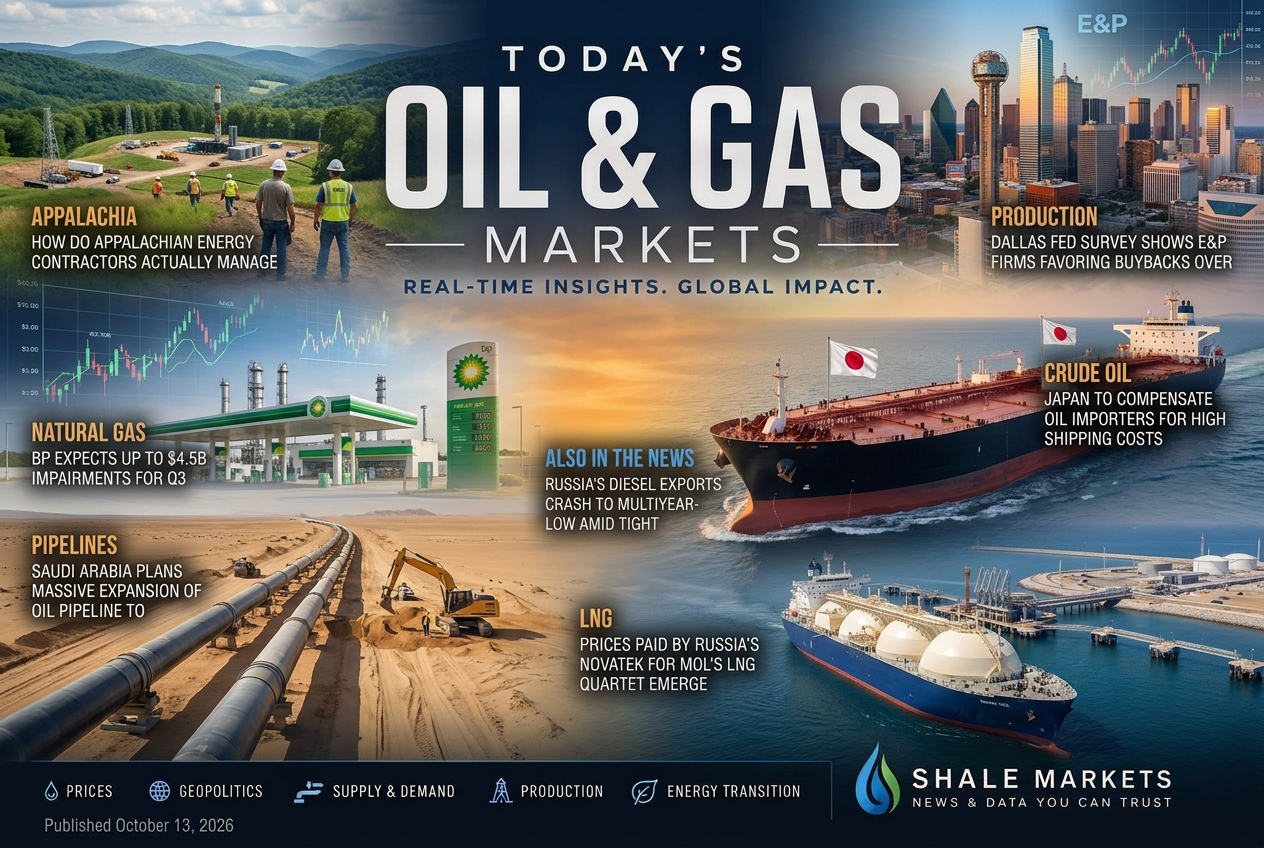
Large E&P firms told the Dallas Fed they'd rather return cash to shareholders than drill, even as spot crude traded near $99 and their own 2026 price forecast sat at $88.
From Our Desk
natural-gas
BP is signaling a material write-down tied to its gas and low-carbon portfolio, which suggests prior capital has not been earning the returns the company expected. For executives, it is a reminder that portfolio simplification and discipline around transition spend remain under pressure even at a major integrated player.
RigZone
Pakistan’s gas shortfall points to immediate supply stress in a market that depends on imported molecules and cross-border flows. For operators and LNG traders, it signals tighter regional competition for gas and more pressure on policy makers to secure alternative supply routes and storage.
IANS LIVE
TotalEnergies is locking in the supply chain for a gas development in Azerbaijan, which signals continued commitment to the project and near-term spending on field buildout. For service and tubular suppliers, it points to sustained activity tied to offshore gas infrastructure rather than just headline project announcements.
OGJ - Exploration and Development
crude-oil
Japan is willing to subsidize higher freight costs to keep crude flowing from a wider set of suppliers, which signals that supply security is now taking priority over the cheapest delivered barrel. For importers and traders, that can improve access to alternative grades and support shipping demand, while reinforcing Asia’s role in the global competition for seaborne barrels.
OilPrice.com
Saudi Arabia is signaling it wants more export flexibility and less dependence on the Strait of Hormuz, which matters for supply security and for how much crude can move even if the corridor is disrupted. For operators and traders, the expansion points to a larger buffer in Saudi spare logistics capacity and a stronger ability to redirect barrels through non-Hormuz routes.
OilPrice.com
SK earthon’s startup in Vietnam adds new offshore barrels to the regional supply mix and shows the company moving from development into cash flow. For executives, the significance is that capital is now translating into production in Asia-Pacific offshore acreage, which can support further investment or partnerships in the basin.
The Korea Times
Any move on Hormuz directly affects a critical chokepoint for crude and LNG flows, so executives should read this as a supply-risk signal for freight, insurance, and regional export volumes. Even without a confirmed decision, the uncertainty can support near-term volatility in seaborne barrels and prompt contingency planning across Middle East-linked supply chains.
Oil & Gas 360
Higher Black Sea shipping insurance costs raise the delivered price of crude and can force traders and refiners to rethink routing, cargo economics, and exposure to regional risk. For operators tied to Russian or Bulgarian supply chains, it signals that maritime disruption is now showing up directly in transportation economics rather than just headlines.
OilPrice.com
This is another sign of consolidation in the Delaware Basin, with Matador adding operated acreage and development inventory rather than chasing a broader corporate pivot. For executives, it points to continued private-to-public asset recycling in core Permian-style acreage where scale and drilling runway still command capital.
RigZone
The return of Japan-linked carriers to direct Middle East loadings points to tighter shipping economics and a normalization of trade routes for crude flows. For oil companies and traders, it signals that freight and logistics costs are still a material part of supply-chain decisions and can influence cargo placement and delivery options.
RigZone
The government’s move to secure crude imports through November signals a near-term supply-management effort to keep domestic diesel markets stable. For refiners and traders, it suggests authorities are focused on avoiding a disruption that could tighten product availability and force more aggressive procurement.
news.sbs.co.kr
A gradual rebound in Gulf oil output signals that supply disruptions are easing, which can affect regional production forecasts and near-term crude availability. For operators and investors, it is a reminder that Gulf supply can come back in stages rather than all at once, shaping basin logistics and price expectations.
ABC Columbia
Japan is signaling a push to harden regional oil security through more storage and infrastructure, which can support longer supply chains and create opportunities for midstream and terminal investment. For producers and traders, it points to a policy-driven effort to reduce disruption risk and keep Asian crude demand more resilient.
RigZone
The higher September crude benchmark signals better realized pricing for Indonesia’s upstream producers and supports near-term cash flow. It also points to firmer local supply-demand conditions that can influence capital spending and field economics.
Petromindo
lng
This points to continued Arctic LNG logistics and ownership reshuffling around Russian exports, which matters for operators watching sanctioned supply chains and tanker availability. For executives, it signals where cargoes can still move and how asset sales can reshape control over gas flows into a tighter market.
TradeWinds News
Tight LNG supply is forcing buyers to lean back on coal, which signals weaker gas affordability and a shift in fuel mix heading into winter. For producers, traders, and LNG exporters, that points to a market where cargo routing, pricing, and supply reliability are directly affecting demand for competing fuels.
OilPrice.com
India is prioritizing city gas allocations even as disrupted LNG imports threaten industrial and power-sector gas availability. For executives, this signals tighter regional gas balance and a more uncertain import outlook for South Asia, which can shift buying patterns and support domestic gas supply assets.
PSU Watch
Warmer winter weather in key Asian LNG buyers could soften near-term import demand and leave more spot cargoes available for Europe. For LNG sellers and traders, that points to looser cargo competition and a potential shift in arbitrage flows this winter.
OilPrice.com
Drilling
Afentra is adding another offshore Angola well, which signals continued capital deployment into a producing basin rather than a pause in activity. If the well performs to target, it supports near-term output growth and strengthens the company’s position in a competitive West African offshore portfolio.
World Oil - Latest News
The added backlog signals that offshore drilling demand is still supporting long-duration utilization for Transocean, which helps defend dayrates and visibility for rig deployment. For E&P operators like Equinor and Shell, it shows continued commitment to North Sea offshore work despite capital discipline elsewhere.
World Oil - Latest News
Murphy is signaling that its exploration program is still delivering across multiple basins, which supports future reserve replacement and keeps capital flowing toward areas with repeatable drilling results. For executives, the key takeaway is that successful wells in several regions can strengthen development inventory and improve the company’s competitive position.
StreetInsider
SLB is adding local drilling-fluid capacity in Mozambique to keep offshore work moving without relying as heavily on imported logistics. For operators and service companies, it signals continued capital commitment to the basin and a deeper service footprint ahead of additional offshore activity.
World Oil - Latest News
Sonangol is extending offshore work in Angola with new drilling and a sidetrack aimed at bringing additional barrels on stream later in the decade. For executives, this signals continued capital commitment to mature offshore acreage and a focus on lifting recovery rather than leaving volumes behind.
OGJ - Drilling & Production
Higher OCTG prices point to firmer tubular demand and better pricing power for suppliers tied to U.S. drilling activity. For operators, it is a cost inflation signal that can pressure well economics and nudge procurement and rig plans.
GMK Center
exploration
Murphy Oil’s offshore work in Vietnam and Ivory Coast points to where it is still willing to place exploration and development capital outside the U.S. For executives, it signals continued focus on international offshore growth and the competitive need to secure future volumes in basin areas that can move company reserves and production.
Baird Maritime
A proposed Cook Inlet lease sale signals another attempt to open new offshore acreage for future capital deployment in Alaska. For operators, the acreage size and royalty terms matter because they shape bidding appetite, partner interest, and the long lead time for adding regional supply.
World Oil - Latest News
Middle Eastern funding for a Falklands explorer suggests outside capital is still willing to back frontier offshore prospects where local operators need financial support. For executives, it signals that capital is available for high-risk exploration if the acreage has a clear development story and geopolitical constraints are manageable.
The Telegraph
This signals continued portfolio reshuffling in Indonesia, with state-linked and local players adding upstream gas exposure rather than letting those assets sit with smaller operators. For executives, it points to ongoing competition for producing fields and discoveries in a market where domestic supply and reserve replacement still matter.
OGJ - Exploration and Development
completions
This expands Ranger’s U.S. well services footprint by adding coiled tubing, fluid, and nitrogen pumping assets, which points to continued spending on completion and intervention capacity even as operators stay selective. For service companies, the deal can tighten positioning in active basins by giving Ranger more equipment scale and a broader toolset to compete for work.
World Oil - Latest News
Midstream
Repeated fire damage on the Line 5 worksite raises schedule and cost risk for Enbridge’s effort to keep the pipeline project moving through Wisconsin. For executives, it is a reminder that permitting and construction risk on controversial pipe projects can still disrupt capital deployment and delay midstream capacity.
WPR
refining
The headline signals that diesel trade flows are still being shaped more by regional supply security than by any bilateral deal. For refiners, traders, and shippers, that means Middle East disruption risk can still override a push to redirect Russian product barrels.
OGJ - General Interest