
Shale Markets Briefing — October 21, 2026
Wednesday, October 21, 2026
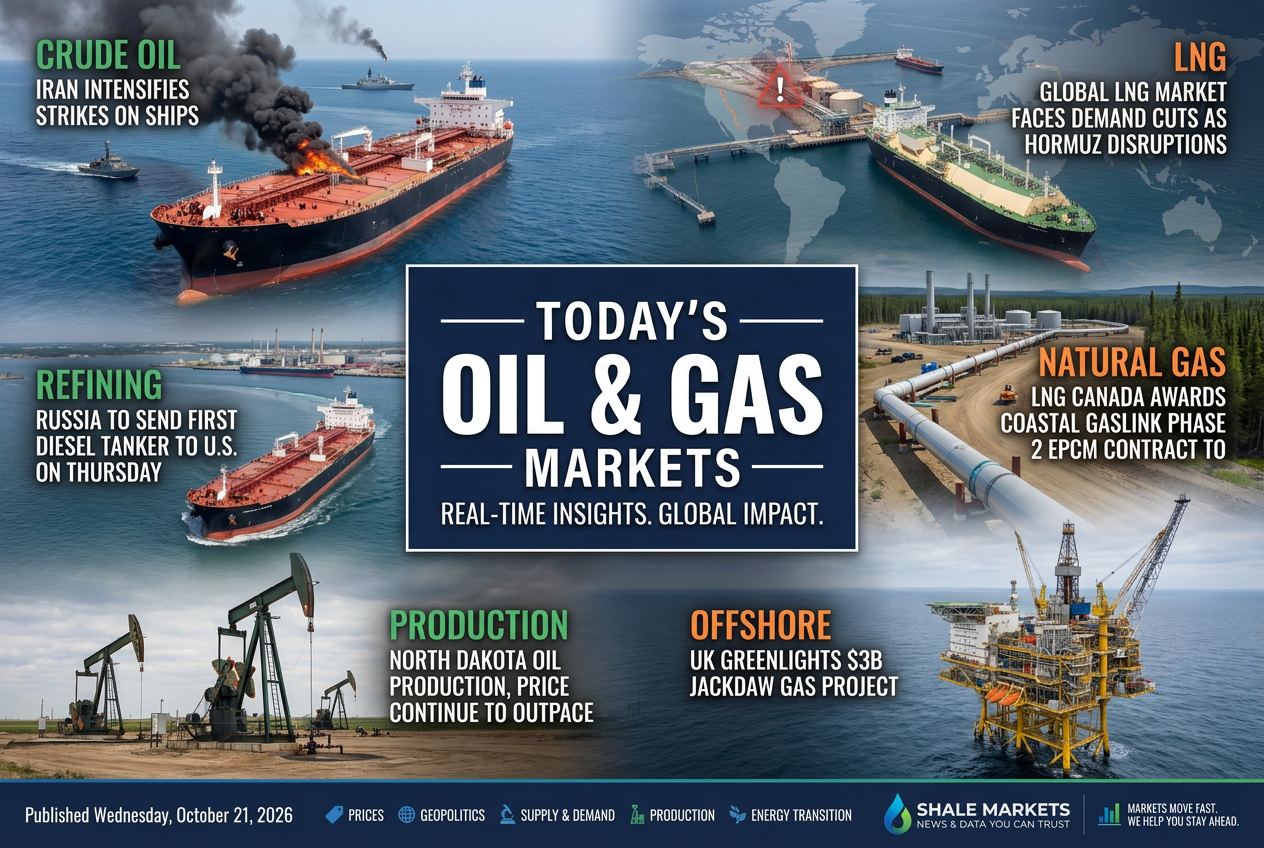
Today's briefing brings you 23 stories across crude oil, lng, refining and natural gas from across the global oil and gas market. Leading today: Iran Intensifies Strikes on Ships.
crude-oil
Escalating attacks on shipping lanes around Hormuz raise the risk premium on crude and LNG exports that depend on the passage. For operators and traders, the immediate issue is vessel security and whether exporters have to reroute or slow loadings, which can tighten prompt supply even without a change in production.
RigZone
Higher-than-expected North Dakota output signals that Bakken supply remains resilient, which can keep regional takeaway, completion, and service demand firmer than budgets may have assumed. For operators and midstream owners, it also suggests the basin may stay more competitive for capital even if the price outlook is only modestly stronger.
Prairie Public
This is an accretive upstream consolidation in a Canadian light-oil basin, signaling that smaller operators still see value in adding barrels and inventory through acquisition rather than only drilling growth. For industry executives, the key point is that capital is still being deployed toward bolt-on deals that can lift production scale and operating leverage in established plays.
Oil & Gas Middle East
Refineries adjusting to smaller tanker lots points to a change in crude sourcing and logistics rather than a pricing headline. For operators and traders, it can signal tighter port constraints, shifting import patterns, or a need to match feedstock flows to more fragmented demand.
Inspenet
lng
Disruptions through Hormuz threaten the physical flow of LNG just as buyers in Europe are already drawing down inventories, which can force demand rationing and keep pricing power with suppliers that can still move cargoes. For operators and traders, it highlights route risk as a direct constraint on gas availability and project economics well beyond the immediate conflict zone.
OGJ - General Interest
The contract signals LNG Canada is still investing in pipeline debottlenecking and upstream gas takeaway to support a larger export footprint. For executives, it shows more midstream capital is being committed to secure feedgas capacity and protect the competitiveness of the Kitimat LNG project.
OGJ - Pipelines and Transportation
This signals continued capital commitment to East Africa gas monetization, with the next phase centered on the infrastructure and processing needed to move an LNG project toward output. For industry executives, it is a reminder that frontier basin development can advance through staged contracts even before full-scale production is visible.
OGJ - Drilling & Production
refining
A Russian diesel cargo bound for the U.S. signals a shift in product trade flows and a willingness to reroute supply even amid geopolitical friction. For refiners and traders, it points to tighter attention on diesel availability, arbitrage economics, and the durability of transatlantic product logistics.
OilPrice.com
The piece points to a potential increase in diesel supply, which matters because distillate balance is a direct read on refinery runs, product inventories, and margin pressure. For downstream operators and traders, the key implication is whether extra barrels will ease tightness in heating oil and trucking fuel or force refiners to adjust product yields.
RigZone
natural-gas
UK approval of Jackdaw clears a major North Sea gas development that can support domestic supply and upstream spending, while signaling continued regulatory support for new gas projects. For operators, it reinforces that capital is still finding its way into sanctioned offshore gas where the policy and economics line up.
RigZone
Norway’s output drop tightens near-term European gas supply just as winter demand is about to rise. For executives, it is a reminder that upstream reliability in a key supplier basin can quickly affect storage draws, import needs, and trading leverage across the continent.
OilPrice.com
offshore
Petrobras’ offshore expansion points to tighter demand for rigs, vessels, and other support equipment in Brazil’s deepwater market. For operators and contractors, that means higher dayrates, tougher logistics, and a stronger pull of capital toward offshore activity rather than onshore shale.
OilPrice.com
A strike at an offshore services contractor can delay subsea work and add cost pressure for operators that depend on third-party vessel and inspection capacity. It also signals labor risk in the North Sea services chain, where tight schedules and limited backfill can affect project timing.
RigZone
Kistos is showing that brief operational downtime can be offset by bringing new wells online, which matters for keeping near-term output and cash flow aligned with guidance. For upstream investors, the Oman deal and the new Balder and King wells signal continued capital commitment to sustaining production rather than simply managing decline.
World Oil - Latest News
This removes aging North Sea production infrastructure from the balance sheet, which is a sign of disciplined late-life asset management rather than growth spending. For operators in mature basins, it highlights the capital and regulatory burden of decommissioning that competes with new drilling and redevelopment dollars.
World Oil - Latest News
Drilling
bp is signaling more capital for deepwater Gulf of Mexico development by lining up subsea equipment for its Paleogene projects. That points to long-cycle offshore spending and supports the service and subsea supply chain tied to future Gulf output.
OGJ - General Interest
The new Gulf contracts extend Transocean’s visible backlog and give offshore drillers more revenue certainty heading into 2027. For operators, it signals that deepwater rig demand in the U.S. Gulf is still firm enough to support long-cycle capital commitments.
World Oil - Latest News
Nigeria’s regulator is signaling that underused oil licenses may not be allowed to sit idle, which raises the pressure on holders to commit capital or risk losing acreage. That can accelerate drilling and asset turnover, and it tells operators the country wants production growth rather than warehousing of licenses.
TheStar
Masirah Oil is moving forward with offshore drilling at Yumna after delays, which signals a potential shift from waiting on project execution to spending capital on development. For executives, the key takeaway is that offshore timing risk can still affect basin momentum and cash deployment even in smaller regional programs.
Offshore Engineer Magazine
This signals that Permian activity is pushing further into municipal policy and land-use limits, which can affect where operators can place wells and how quickly they can develop inventory around Midland. For executives, it is a reminder that local approvals and community pushback can shape drilling density, permitting risk, and the cost of maintaining production growth in core shale areas.
CBS7
exploration
Viridien is investing in seismic reprocessing to sharpen the subsurface picture around offshore Guyana, which can help operators de-risk acreage that sits near one of the region’s most important oil discoveries. For executives, this signals where future appraisal and exploration capital may migrate if the data improve prospectivity outside the core Stabroek area.
World Oil - Latest News
completions
The Bakken is still adding wells, but the mix is tilting toward gas rather than meaningful oil growth. That suggests operators are pushing inventory to keep activity up while the basin’s crude output may be nearing a plateau, which affects capital allocation and takeaway planning.
Hart Energy
A spring rebound in U.S. frac activity would point to renewed completion spending after a slower stretch, which is a positive signal for pressure-pumping companies and for operators that need to turn drilled inventory into production. It also suggests basin-level activity is firming enough to support service utilization and keep unconventional output growth moving.
Hart Energy